|
John 8:28-29
“So Jesus said ... He has not left me alone, because I
always do what is pleasing to him.’ ”
Matthew 27:46
“Jesus cried out in a
loud voice, ‘Eli, Eli, lema sabachthani?’ which means, ‘My God, my God,
why have you forsaken me ?’ ”
NAB
Some people have contended that Jesus was stating a theological
fact that the Father had forsaken Him while He was on the Cross.
However, this Bible quote above in Matthew is a quotation from the Old
Testament Psalm 22.
Jesus was not just reciting this passage. He was
praying it, and doing so for our benefit.
Jesus was fully human. He fully experienced the pain of death and the feeling of separation.
Please consider the following:
John 11:41-43
“And Jesus raised his eyes and said, ‘Father, I thank you for hearing me.
I know that you always hear me; but because of the crowd here I have said this,
that they may believe that you sent me.’ … ‘Lazarus, come out !’ ”
Two things can be seen from this passage. First, the
Father always hears the Son. Second, Jesus prays out loud for the benefit
of His hearers. Therefore, when he prayed Psalm 22, out loud, from
the cross he brings to His followers’ mind’s the triumphal meaning that is
revealed at the end of that Psalm. Jesus knew that His listeners would
have been reminded of the rest of that prayer.
Psalm 22: 2, 22-25
“My God, my God, why have you abandoned me? …
Save me from the lion’s mouth,
my poor life from the horns of wild bulls.
… For God has not spurned or disdained
the misery of this poor wretch,
Did not turn away from me,
but heard me when I cried out.”
NAB
Jesus was giving us a message of hope when we follow him
to the cross. Luke 9:23-24.
Even though believers in God may feel abandoned when they suffer, in reality
God the Father is closer than ever. What earthly father would not desire
to be near his son when he is suffering. Certainly an earthly father
is not more loving than God the Father.
If we say that Jesus was “forsaken” in an absolute sense, that would make
the Father a schizophrenic God, One who tells Jesus to do something
and then when Jesus obeys, the Father forsakes Him. Cf. Garden of Gethsemane
Matthew 26:39.
In support of the first opinion that Jesus was truly forsaken, cursed and had
literally become sin, someone might quote:
Galatians 3: 10-13
“…
it is written, “Cursed be every one who does not abide by all things
written in the book of the law, and do them.”
…
Christ redeemed us from the curse of the law, having become a curse for
us—for it is written, “Cursed be every one who hangs on a tree” ”
Did Jesus become a curse literally or figuratively
?
Again, a person supporting the first opinion may quote :
2 Corinthians 5:21
“For our sake he made him to be sin who knew no sin, so that in him we
might become the righteousness of God.”
Joe Heschmeyer explains that :
“sin” is the term that the Jews used for sin offerings.
The Hebrew word
חַטָּאָת (chatta’ath)
means both “sin” and “sin offering.” So another way of making St.
Paul’s point is to say that Christ, who is sinless, was made our sin
offering.
So Paul’s not calling Christ evil. That’s crucial. Sin
is evil, and so calling Christ “sin” (in the way we use the word)
would be calling Him evil, an obvious heresy (particularly since
Paul just said that Christ is sinless). Calling Him our
sin offering, on the other hand, is completely orthodox.
Christ died for our sins: that’s the foundation of Christian
theology.
See
Joe Heschmeyer’s website
Jesus compares Himself to
the image of a serpent.
John 3:14
“And as Moses lifted up the serpent in the wilderness, so must the Son
of man be lifted up”
But, to understand this we must study the Old
Testament passage that Jesus was talking about.
Why Looking at Serpent in OT Brought Healing
Numbers 21:5-9
“And the people spoke against God and against Moses, “Why have you
brought us up out of Egypt to die in the wilderness? …
6
Then the Lord sent fiery serpents among the people, and they bit the
people, so that many people of Israel died.
7
And the people came to Moses, and said, “We have sinned, for we have
spoken against the Lord and against you ...
8
And the Lord said to Moses, “Make a fiery serpent, and set it on a pole;
and every one who is bitten, when he sees it, shall live.”
9
So Moses made a bronze serpent, and set it on a pole; and if a serpent
bit any man, he would look at the bronze serpent and live.”
The image of the serpent – the snake – is usually
associated with the devil. See Genesis 3. So why does looking upon it
bring healing? Because the Jews had compared God to the evil one, one
who brings death, Satan and, now looking upon this image was a humble
acknowledgment of their sin. They had claimed God was like Satan, the
serpent. This brought about repentance.
Just as the serpent Moses lifted up became symbolic
of the insult the Jews made against God, Jesus death was symbolic of our
sins. Jesus did not become literally cursed, but rather His death was
symbolic of one who had been cursed. Jesus could never have been
literally cursed because of His devotion and nearness to God the
Father. This is seen below.
Hebrews 5:7-9
“… he (Jesus) was
heard because of his reverence.
Son though he was …
he became the source of eternal salvation for all who obey him.”
Because Jesus was fully God, He could never have
become sin in the literal sense of the word. St. Paul was referring to how Jesus accepted the suffering that was due to
our guilt.
As part of Mankind, He represents us and He dies
for our sins. From the earthly perspective Jesus appeared as cursed and
as forsaken, but from the heavenly perspective – the only true
perspective – Jesus was glorified on the cross as He tells us in …
John 12:23-33
“And Jesus answered them,
“The hour has come for the Son of man to be glorified.
Truly, truly, I say to you, unless a grain of wheat falls into
the earth and dies, it remains alone; but if it dies, it bears much
fruit. …
And what shall I say?
‘Father, save me from this hour’?
No, for this purpose I have come to this hour.
28 Father,
glorify thy name.” …
Now is the judgment of this world,
now shall the ruler of this world be cast out;
and I,
when I am lifted up from the earth,
will draw all men to myself.”
He said this to show by what death he was to die.”
Jesus was paying our debt for sin. Jesus died on the cross to
restore holiness in Mankind not to just fulfill some legalistic rule.
Certainly, the Father was not just getting His blood’s worth of revenge.
It was the pagan “gods” who punished just for the sake of revenge.
Sin by its very nature always brings destruction and suffering into the world.
By accepting the suffering due to our guilt Jesus enables our hearts to be
opened up to having a true faith , so that it will even be open to accepting
the suffering of the cross. Jesus was doing much more than just fulfilling
some legalistic requirement, He was enabling us to become truly loving and
holy by His grace which works within us. Even when God inflicts punishment
He does so with more love than any human being could imagine.
Luke 22:37
“For I [Jesus] tell you that this scripture must be fulfilled
in me, namely, ‘He was counted among the wicked.’ ”
Even though He was counted among the wicked surely He was not wicked since
He was without sin.
A FATHER’S LOVE FOR HIS
SON
Jesus was never more glorious to the Father than when Our Savior hung on
the Cross.
John 12:23
“Jesus answered them, ‘The hour has come for the Son of Man to be
glorified.’ ”
John 17:1
“When Jesus had said this, he raised his eyes to heaven and said, ‘Father,
the hour has come. Give glory to your son, so that your son may glorify you’ ”
Consider,
Isaiah 53:4
“Yet it was our infirmities that he bore, our sufferings that he endured, While
we thought of him as stricken, as one smitten by God and afflicted.”
“While we thought of him as stricken …” seems
to imply that He was not really forsaken. As does the following prophecy.
Psalm 31:23
“Once I said in my anguish, ‘I am shut out from your sight.’
Yet you heard my plea, when I cried out to you.”
JESUS IS ONE WITH THE
FATHER
John 14:8-11
“Do you not believe that I am in the Father and the Father is in me?
… The Father who dwells in me is doing his works. Believe me
that I am in the Father and the Father is in me … ”
John 8:28-29
“So Jesus said (to them),
‘When you lift up the Son of Man, then you will realize that I AM, and that
I do nothing on my own, but I say only what the Father taught me.
The one who sent me is with me. He has not left me alone, because I always
do what is pleasing to him.’ ”
So, it is appropriate to ask, “What was the Father’s plan, His Will, for
Jesus ? And when did Jesus do that ?”
In the Garden of Gethsemane Jesus prayed,
Matthew 26:39
“My Father, if it is possible, let this cup pass from me; yet, not as I will,
but as you will.”
John 10:17-18, 30
“This is why the Father loves
me, because I lay down my life in order to take it up again.
No one takes it from me, but I lay it down on my own. I have power to lay it
down, and power to take it up again. This command I have received from my
Father … The Father and I are one.”
John 15:9-10
“As the Father has loved me, so have I loved you …
just as I have kept my Father’s
commandments and abide in his love.”
Therefore, Jesus was never more lovable then when he was
on the Cross. It was then that Jesus was doing what was pleasing to
the Father, giving His life in love for the Father and His will. And
as John 8:28-29 points out, God the Father could
not have left Him alone at this or any other time.
John 16: 32- 33
“Behold, the hour is coming and has arrived when each of you will be scattered
to his own home and you will leave me alone. But I am not alone, because
the Father is with me. I have told you this so that you might have
peace in me.”
NAB
This passage refers to when Jesus will be abandoned by most
of the Apostles at the Cross, yet, Jesus informs us that the Father is, and
will be, with Him at that time. Further, He says that this is to give
us peace. He is implying that we will be treated by our Heavenly Father
in our time of trial the same way the Father treated Him. We will not
be abandoned or forsaken, it will only appear to be that way. See the
end of the Psalm above. Christians are called to see the fullness of
reality not by natural means but by supernatural faith, hope and love.
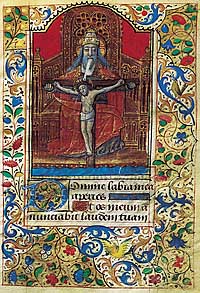
Image at Top is from : Book
of Hours, Paris, 1470 AD
|