Library









|
DEFENDING THE BRIDE
|
| How can we prove that the verses below do not
prove that Mary had other Children ? Objections to Mary’s Perpetual Virginity
Brothers - Matthew 13:55 and Mark 6:3 Brothers ?
Jesus is said to have had brothers. The Greek word for “brothers” is “adelphos” and it is a compound word. A = “same” and delph = “womb.” So, some Protestants argue that these “brothers” of Jesus must be from the same womb as Himself and thus children of Mary, His mother. However, this is an etymological fallacy. The derivation of a word, its etymology, will give you the history of a word, but it does not necessarily give you the correct definition of that word at the time it was used. Objection: Answer: In the Hebrew language there is no word for cousin or nephew. This close family culture referred to them all as brothers. The Old Testament was translated into Greek around 100 B.C. in what is called the Septuagint.
The New Testament writers used this Septuagint , a
Greek Translation of OT. , when quoting the Old Testament.
Out of the 350 total quotes of OT, the Septuagint was used .300 times. The translators used the Greek word “adelphos,” or a derivative of that, to describe any of these close family relations. The New Testament writers used this same pattern to describe Jesus’ close family relations even when they were not Mary’s children. We can see this pattern carried over in some modern
translations. For example, we see this pattern in the
description of Abram and Lots’ relationship which was really uncle and
nephew.
In order to get past the prejudice of to how to interpret
the word “adelphos”
which is used in reference to Jesus, it is beneficial to consider
other Bible passages that also use that word, but in a different context.
|
|
|
|
| Discovering the identity of Jesus’ brothers will be aided by examining who is His Mother’s sister. The phrase “his mother’s sister,” in Jn 19.25 [below], is a reference to the mother of the sons of Zebedee , a.k.a. Salome. Perhaps it was Salome’s close relationship with the Blessed Virgin Mary that emboldened Salome to make the seemingly presumptuous request of Jesus that her sons sit at his right and left. (Matthew 20:20-21. Saint Salome, please pray for us.) The identification of “his mother’s sister,” as Salome is also evident when we compare Matthew 27:56, Mark 15:40, and John 19:25 [see quotes below.] These passages show a consistency whereby each of these three Gospels lists all three of the women at the cross besides the Blessed Virgin Mary. [ It would have been self evident that a loving, Jewish and presumably widowed mother of an only child would have been at the cross. Stating that the Blessed Virgin Mary was there would have been practically redundant. Therefore, there was no need for Matthew or Luke to do so. While, John does go out his way to state that she was there, this seems to be in order to draw his readers into the realization of Mary’s role as the New Eve. See MARY the “WOMAN” ] Those other
three women at the cross are However, we know that Mary and
Salome were cousins (see family tree below)
so this is an example of “adelphos” (actually, the feminine
version of the word in this case), being used with a wider definition
than just children from the same womb. |
|
St. Papias,
Early church writers record that Salome, Zebedee’s wife, was actually the cousin of the Blessed Virgin Mary. See quotation below chart. The fact that they are called “sisters” in the Bible verse above shows that the word “sister” had a less restricted meaning and included close relatives. (The Greek word used in the Bible is the feminine version of “adelphos.”)
|
|
|
|
|
|
|
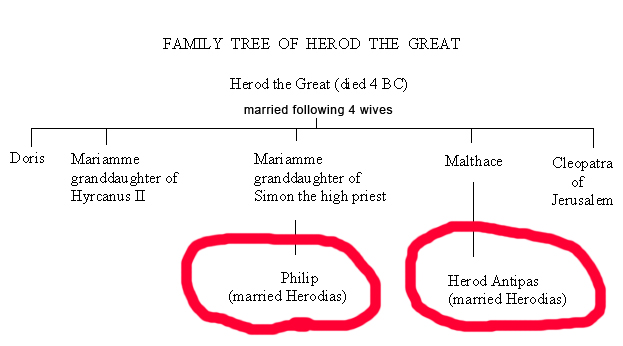
| Here is another example. We know that King Herod (Antipas the Tetrarch) and Philip are called brothers (Greek: adelphos) in Mark 6.17. Yet, we know that they are not from the same womb [as the derivation of that word might suggest.] Their father King Herod the Great had many wives and these brothers “adelphos” were born of different mothers. |
|
|
|
|
(See DICTIONARY OF THE BIBLE by John L. McKenzie,S.J., page 355 for a more detailed chart of Herod's family. Note: Philip , the first husband of Herodias, is sometimes called
James, The Brother of the Lord Galatians
1:19 There are two Apostles named James. However, it is clear that neither one of the Apostles named James is the son of Joseph and Mary. They are stated to be the “son of Zebedee” and the “son of Alphaeus” in the lists of the Apostles. See Mark 3:14-19, and Matthew 10:2-4. Mark
3:14-19 When we compare these texts with John 19:25 we can deduce that Clopas and Alphaeus must be the same person. This can be easily explained, as Karl Keating points out, because the Aramaic name Alphaeus can be rendered in the Greek as either Alphaeus or as Clopas. Or Alphaeus could have taken a Greek name similar to his Jewish name the same way as Saul took the Greek name Paul. In the second century church historian Hegesippus explained that Clopas was the brother of Joseph, Mary’s husband. Therefore, by marriage, Clopas’s sons and Jesus were close relatives, and hence they were called brothers in close knit familial society of the Hebrews. Another example is, Plato (429 -347 BC) in his LAWS XI 924 E for his model state: “That brother [adelphos] who is born of the same father or of the same mother …” Therefore, the word “adelphos” cannot necessarily mean from the same womb. Plato also uses the same word to mean “kindred, or relatives.” Therefore, the reference to the brothers and sisters (ADELPHOS) of Jesus does not mean that Mary had other children.
Also see the following objections answered: Read more at Mary's Perpetual Virginity Was Implied Protestant Reformers Affirm Mary's Perpetual Virginity
Links To Other Sites On This Subject
|
|

See Articles at