|
Working
Toward A Good Translation, And A Good Theology
Church Fathers
There is some disagreement
over how best to translate Matthew 24:28 into the vernacular. Some will
translate it as follows, “Wherever the corpse is, there the vultures
will gather.” However, the original Greek does not use the term
“vultures.” It clearly uses the term for eagles, “aetoi,” the plural
for Strong’s #105, “aetós.”
The Greek word used here in Matthew 24 is
also used in the parallel passage in Luke 17:37. The only other uses
for this word are Revelations 4:7, 8:13, and 12:14.
The context of each of these passages clearly refers to a heavenly
creature doing God’s will.
So, why do some purposely
mistranslate the Greek word for “eagles” and use “vultures?”
(See Protestant Bible
Dictionary.)
Their
reasoning is connected to the Greek word for “body.” [Strong’s #
4430] It is based on two words which mean a “body” and an adjective
meaning “fallen.” So, it is sometimes translated as “corpse.”
Now, an eagle is a
predator that only goes after live prey.
Vultures, or buzzards, are
scavengers that feed on carcasses, the deader the better. So, some
translators substitute vultures even though the Greek uses “eagles”
since they reason that it fits better with a “fallen body.”
I contend that the
Catholic translation that is found in older Bibles which used the word “eagle” is better and that this
passage refers to the Sacrifice of the Mass around which God the Father
would gather His children till the end of time.
Although, the Greek word
for Body refers to a fallen body – for example, this same Greek word is
used to refer to Christ’s Body when it is taken down from the cross in
Mark 15:45 – I believe that it is a reference to eternal sacrifice of
the Mass where Jesus is perpetually offered to God the Father both in
Heaven and re-presented here on earth at the Sacrifice of the Mass.
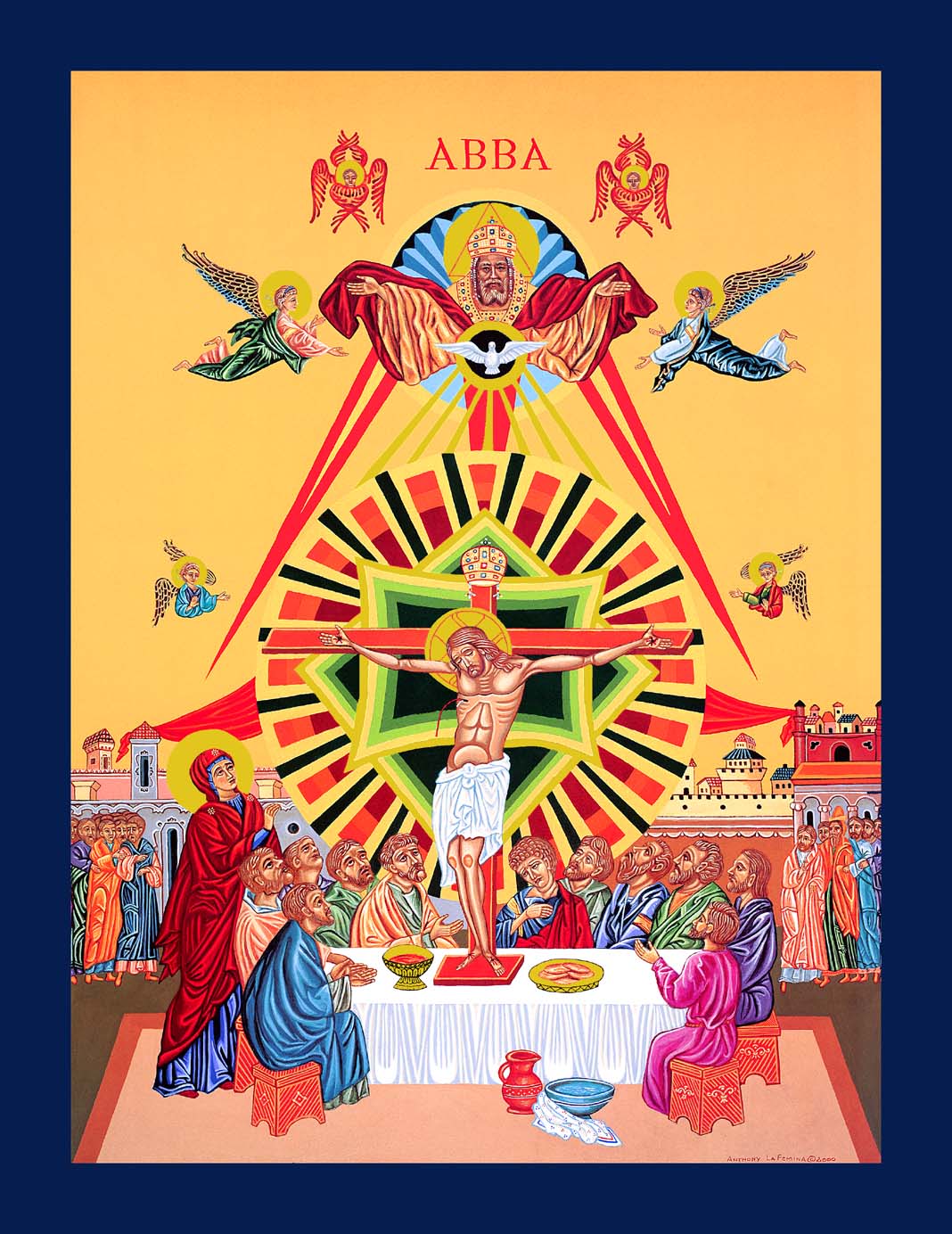
1 Corinthians 11:26 “For as often as you eat this bread and
drink the cup, you proclaim the death of the Lord until he comes.”
Consider:
Revelation 5:6
“And between the throne and the four living creatures and among the
elders, I saw a Lamb standing, as though it had been slain …”
The Lamb, a symbol for
Jesus who is our Paschal Lamb, is standing. Standing is the posture of
the officiating Old Testament priest. And this Lamb appears as though
He has been slain. Christ is both the Eternal High Priest and the
Victim. So, this imagery fits perfectly with our understanding of Jesus
offering Himself to God the Father once for all time, eternally in
Heaven.
Hebrews 7:24-25
“ but he [Jesus] holds his priesthood permanently, because he continues
for ever. Consequently he is able for all time to save those who draw
near to God through him, since he always lives to make intercession for
them.
And
Hebrews chapter 10
goes on to warn those who knowingly sin and deliberately refuse to avail
themselves of the graces offered by the Sacrifice of the Mass no longer
have any sacrifice that expiates their sins since there is no other
Savior except Jesus.
A Weak Theology
Some lay “Catholic”
educators have ignored and in some cases even denied the sacrificial
nature of the Mass and contended that it is only a communal meal. The
Holy Father John Paul II has corrected this misunderstanding in his
encyclical letter Ecclesia De Eucharistia (2003 AD),
“10. … Unfortunately,
alongside these lights, there are also shadows. … At times one
encounters an extremely reductive understanding of the Eucharistic
mystery. Stripped of its sacrificial meaning, it is celebrated as if
it were simply a fraternal banquet.”
Perhaps the difficulty in
recognizing the association between the “fallen body” in Matthew 24:28
with our Paschal Lamb, “standing as though slain,” has been due to these
shadows and bad theology that Pope John Paul II speaks about.
Matthew 24:23-28 - the
Context
In Matthew chapter 24 Jesus tells us not to be alarmed by false
declarations that the second coming has occurred and that He is either
here or there. After saying where He is not it is natural that He would
then say where He will be.
Verses 27-28 record Jesus’s conclusion, “For as
the lightning come forth from the east and shines even to the west, so
also will the coming of the Son of Man be. Wherever the body is, there
will the eagles be gathered together.”
In the parallel passage in
Luke 17: 20-37 Jesus also tells of His second coming. He tells of how
“one” will be taken and one will be left. His disciples asked Him,
“Where, Lord?” And in verse 37 Jesus replies, “Wherever the body is,
there will the eagles be gathered together.”
The word used for “body”
in the above verse is the same Greek word used in the institution of the
Eucharist when Jesus said, “This is my Body.”
It is also interesting to
note that the Greek does not state that the eagles will gather, rather
it says that the eagles will be gathered. Perhaps this is allusion to
John 6:44 “No one can come to me unless the Father who sent me draw
him, and I will raise him on the last day.”
It is God the Father who
moves people’s hearts with the gift of faith to accept what Jesus
promises in John 6. So, it is God the Father who is doing the gathering
of the eagles by blessing them with the gift of faith.
Traditionally
the Saints are said to have the eagle eye, that is, the eye of faith.
John 6:53-56 “So Jesus
said to them, ‘Truly, truly, I say to you, unless you eat the flesh of
the Son of man and drink his blood, you have no life in you; he who eats
my flesh and drinks my blood has eternal life, and I will raise him up
at the last day. For my flesh is food indeed, and my blood is drink
indeed. He who eats my flesh and drinks my blood abides in me, and I in
him.’ ”
So, for
these reasons I believe Matthew 24:28 should be translated as follows,
“Wherever the body is, there the eagles will be gathered together.”
A few years after composing the article above I came across
these quotations below.
Church
Fathers on this passage
St. John Chrysostom
“For wheresoever the
carcass is,” says He,
“there also will be the eagles,” Matthew 24:28
calling His body a carcass by reason of His death. For unless He
had fallen, we should not have risen again. But
He calls us eagles, implying that he
who draws near to this Body must be on high and have nothing common with
the earth, nor wind himself downwards and creep along; but must ever be
soaring heavenwards, and look on the Sun of Righteousness, and have the
eye of his mind quick-sighted. For eagles, not daws, have a right to this
table. Those also shall then meet Him descending from heaven, who
now worthily have this privilege, even as they who do so unworthily,
shall suffer the extremest torments.
Homily 24 on First Corinthians
St. Thomas Aquinas
quoting St. Ambose
Luke 17:37 “And they said to him, ‘Where, Lord?’
He said to them, ‘Where the body is, there the eagles will be gathered
together.’ ”
Ambrose;
For the
souls of the righteous are likened to
eagles, .... Now concerning the body, we can have no doubt,
and above all if we remember that Joseph received the body from Pilate. ... But the body is that of which it was said, My flesh
is meat indeed; and around this body are the eagles
...
See St. Thomas Aquinas'
Catena Aurea
St. Thomas Aquinas
Secondly, this belongs to Christ's love, out of
which for our salvation He assumed a true body of our nature. And
because it is the special feature of friendship to live together with
friends, as the Philosopher says (Ethic. ix),
He promises us His bodily
presence as a reward, saying
(Matthew 24:28): “Where the body is, there shall the eagles be gathered
together.” Yet meanwhile in our pilgrimage He
does not deprive us of His bodily presence; but
unites us with Himself in this sacrament
through the truth of His body and blood. Hence (John 6:57) he says: “He
that eateth My flesh, and drinketh My blood, abideth in Me, and I in
him.” Hence this sacrament is the sign of supreme charity, and
the uplifter of our hope, from such familiar union of Christ with us.
(Summa Theologica > Third Part > Question 75 > Question
75. Article 1. Is the Body of Christ in this sacrament truly, or
figuratively? .I
answer that,)
Irenaeus
“the Lord say to His disciples,
“You
have not chosen Me, but I have chosen you” … of whom Esaias
also says, "I
will bring your seed from the east, and will gather you from the west; and I will say to the north, Give up;
and to the south, Keep not back: bring My sons from far, and My daughters
from the ends of the earth; all, as many as have been called in My name: for
in My glory I have prepared, and formed, and made him." Isaiah 43:5 Inasmuch
as then,
“wheresoever the carcass is, there
shall also the eagles be gathered together,” Matthew 24:28
we do participate in the glory of the
Lord, who
has both formed us, and prepared us for this, that, when we are with Him,
we may partake
of His glory.”
(Irenaeus,
Against Heresies, 4:14:1)
Note: Jesus' glory was when He manifested His great
act of love on the cross. See
John 12:23-33
St. John Chrysostom
Having told them how Antichrist comes, as, for
instance, that it will be in a place; He says how Himself also comes.
How then does He Himself come? "As the lightning comes out of the
east, and shines even unto the west, so shall also the coming of the Son
of Man be.
“For wheresoever the carcass is,
there also will the eagles be gathered together.” Matthew 24:27-28
How then shines the lightning? It needs not one to
talk of it, it needs not a herald, but even to them that sit in houses,
and to them in chambers it shows itself in an instant of time throughout
the whole world. So shall that coming be, showing itself at once
everywhere by reason of the shining forth of His glory. But He mentions
also another sign,
"where
the carcass is, there also shall the eagles be;” meaning the multitude of
the angels, of the martyrs, of all the saints.
Homilies on Matthew >
Homily 76
St. Jerome
I think it my duty to consult the chair of Peter,
and to turn to a church whose faith has been praised by Paul. I appeal
for spiritual food to the church whence I have received the garb of
Christ. The wide space of sea and land that lies between us cannot deter
me from searching for "the pearl of great price." Matthew 13:46 “Wheresoever
the body is, there will the eagles be gathered together.” Matthew 24:28
Evil children have squandered their patrimony; you alone keep your
heritage intact. The fruitful soil of Rome ...”
Letters of St. Jerome >
Letter 15
St. Thomas Aquinas
Secondly, to uplift our hope: hence He says (John
14:3): "If I shall go, and prepare a place for you, I will come again,
and will take you to Myself; that where I am, you also may be."
For by placing in heaven the human nature which
He assumed, Christ gave us the hope of going thither; since “wheresoever
the body shall be, there shall the eagles also be gathered together,” as
is written in Matthew 24:28.
Hence
it is written likewise (Micah 2:13): "He shall go up that shall open the
way before them."
Summa Theologica > Third Part > Question 57. Article 1. Did it belong
for Christ to ascend into heaven?
Reply
to Objection 3.
Ambrose
“You have become a good eagle who seeks out heaven,
spurns earth. The good eagles are around the altar: for indeed ‘Where the
body is, there will the eagles be’ [Matthew 24:28]. The altar is the image
of the body, and the body of Christ is on the altar. You are the eagles,
renewed now that the fault has been washed away.”
[Ambrose, De Sacramentis, 4:7, as quoted in the book, Ritual and the Rood:
Liturgical Images … by Éamonn Ó Carragáin, page
145.]
See more comments by
Jerome, Hilary, Origen, Gregory, and Cyril.
Eagles or Vultures
The word in question is the Greek word “aetós” Strong’s # 105.
According to the Protestant J. Thayer Lexicon, the Greek word “aetós”
means eagle. However, he substitutes “vulture” in Luke 17:37 and Matthew
24:28
Thayer’s Lexicon
(Protestant Dictionary)
Aetós -
“an eagle : Rev. 4:7; 8:13; 12:14.
In Matthew 24:28; Luke 17:37 it is better, since eagles are said
seldom or never to go in quest of carrion, to understand with
many interpreters either the vultur(e) percnopterus, which
resembles an eagle, or the vultur(e) harhatus.”
|