Library









|
|
|
Is
Jesus a Human Being ?
The Second Person of the Trinity has always been. Never was there a time when He has not existed. He is Begotten, not made. He is, and always will be One Divine Person with a Divine Nature. At the Incarnation this One Person took on a human nature in addition to His Divine nature and thus He became fully human, and we call Him Jesus. See side bar. Going back to the original question, if by “being” one means a “person” then the answer is most definitely NO. Jesus is ONE person who is Divine. Humanity is part of creation IF we were to say that Jesus is a Human Being, that is a Human person, we would be saying that His Identity or who He is as a Person was created. That would be wrong. His human nature was created, but not His Person or Being. The identity of who He is as a person is eternal. To claim that He is both a human person and a divine person is to fall into the Nestorian heresy. See below.
If by “being” one
means “nature” then we would say that Jesus has a human
being or that He took on a human being at the Incarnation. Some
people chose to define
So, I prefer not to use the problematic terminology of “being.” Rather, I would say it this way. Jesus is ONE person with two natures, fully divine and fully human. He is One Divine Being, or Person, who took on a created human nature about nine months before the Christmas event of about two thousand years ago. He has always had a divine nature.
|
|
|
See Quotations from
the
466
467.
468.
|
|
|
|
|
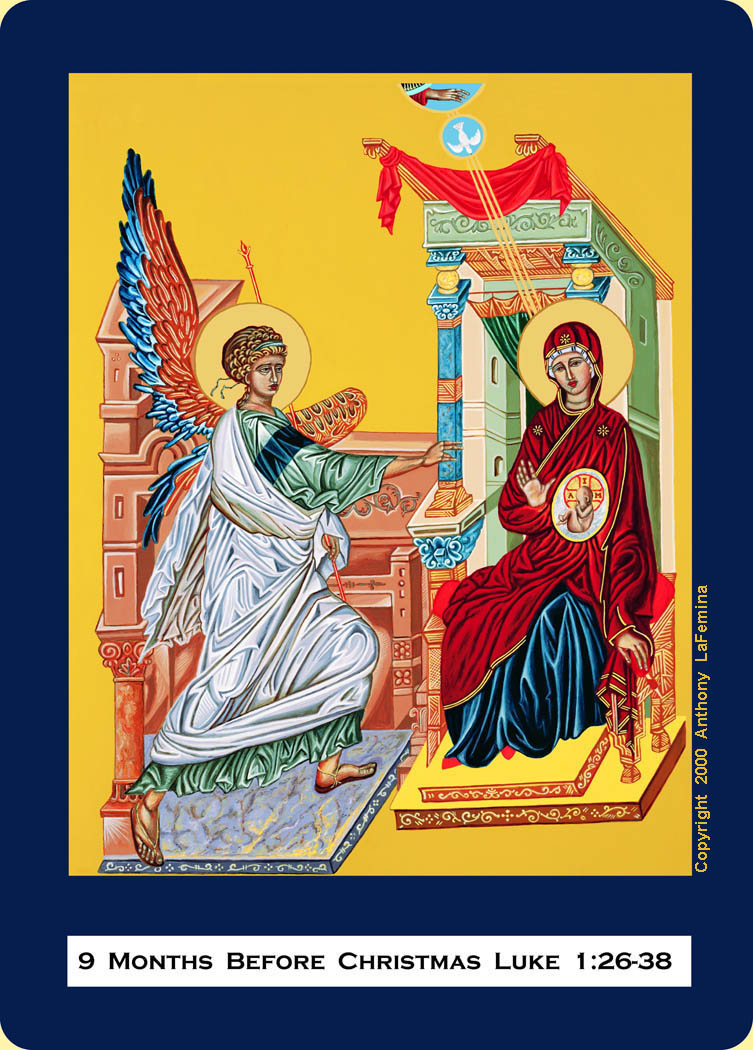
| Notice how the icon above contains and expresses the correct
theological position. Around Jesus' head we see the expression “I
AM (who Am)” which is the name God gives to Himself.
In Hebrew it is Yahweh. Jesus is identifying Himself as God, One
Divine Being. Together with the Father and the Holy Spirit which
are also represented above, make up the Godhead, three Persons in
One Divine Nature.
Jesus says, “I AM” because He is One Person, One Divine Being. He does not say “We Are” because He is not two beings, that is not two persons. He is not a Divine Being and a Human being. He is One Divine Person who also took on a human nature in Mary's womb and became truly man. And so, Mary is the Mother of God, the God-bearer.
Rev. Msgr. Anthony A. La Femina's icons are profoundly deep and rich in their theology. See his Sacrifice-Banquet of the New Covenant which reflects the beauty and the mystery of the Mass.
|
|
|
|
|
||||
|
|
||||